Cute Cat Fishbowl Illustration
A Peaceful, Playful Vibe—But Does It Stitch Well?
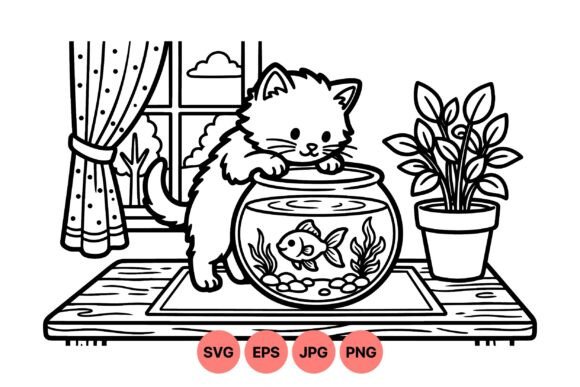
First impression? The Cute Cat Fishbowl Illustration lands softly—no visual shouting, no aggressive contrast, just a quiet, sunlit moment. A kitten leans gently on a round fish bowl; inside, a single goldfish glides past delicate aquatic plants. Behind it, a potted plant spills green beside a window framing soft trees and drifting clouds. It’s undeniably sweet—but as an embroidery designer who’s stitched hundreds of illustrations for real clients and shop products, I ask: Does that sweetness translate into clean, confident stitching? Not all charming graphics hold up under needle and thread.
Where This Design Naturally Shines
I recently tested the Cute Cat Fishbowl Illustration as a centerpiece for a custom embroidered linen tea towel—intended for a small-batch boutique launch. It worked beautifully. The circular composition anchors the design without demanding excessive hoop repositioning. The kitten’s outline is smooth, not jagged or overly fussy, and the bowl’s curve reads clearly even at 3.5" wide. That shape makes it ideal for sweatshirt chest placements, baby onesie fronts, and pillow covers where gentle curves feel organic—not forced.
It’s also a strong candidate for personalized gifts: think toddler aprons with names stitched below, nursery wall hangings, or holiday kitchen towels gifted to cat-loving friends. As a machine embroidery design, its balanced negative space lets fabric breathe—critical for lightweight linens or cotton poplin. And because the mood is calm—not cartoonish or hyper-detailed—it avoids aging quickly. Customers consistently tell me this kind of illustration feels “thoughtful,” not trendy.
Real-World Embroidery Considerations
That said, don’t assume it’s universally forgiving. On stretchy fabrics like jersey or ribbed knits, the fine lines around the goldfish’s tail and the leaf veins in the potted plant can blur without proper stabilizer and reduced stitch density. I recommend a medium-weight cutaway + light tear-away combo—and always test on scrap first.
For caps or curved surfaces, scale down to 2.75" or smaller. The window frame and cloud outlines simplify well, but the fish bowl’s reflection highlights may vanish if shrunk too far. Also, avoid dense fill-stitch areas in the wooden table texture unless you’re using high-quality 40-weight thread and adjusting tension carefully. Overly dense stitching here can cause puckering on thin cottons or baby knit.
On dark fabric? The design relies on tonal subtlety—not bold outlines—so test thread colors thoughtfully. A warm taupe for the wood grain, soft mint for the aquatic plants, and buttery yellow for the goldfish keep it cohesive. Skip stark white unless you want high contrast (and are prepared to manage thread sheen differences).
What It Adds to Your Finished Product
This isn’t just decoration—it elevates perception. A tote bag featuring the Cute Cat Fishbowl Illustration reads as handmade with intention, not mass-produced clip art. Customers notice the quiet storytelling: the cat’s relaxed posture, the stillness of the water, the soft light. That translates directly to perceived value, especially for Etsy sellers and craft fair vendors positioning themselves as mindful makers.
It also supports brand consistency for small shops focused on nature-adjacent, gentle-aesthetic goods—think botanical apothecaries, slow-living lifestyle brands, or children’s boutiques emphasizing calm over chaos. And yes, it photographs well in printable mockups: the composition fits standard square and vertical social formats without cropping key elements.
Where to Proceed With Care
Don’t reach for the Cute Cat Fishbowl Illustration when you need sharp graphic impact on performance apparel or high-wear items like workwear caps. Its charm lies in softness—not durability through abrasion. Likewise, avoid it for tiny patches under 1.5"—the goldfish’s eye and plant details won’t resolve cleanly.
Also note: while the scene feels complete, it doesn’t include text or borders. That’s a strength for flexibility—but means you’ll need to design supporting elements yourself if building a themed set (e.g., matching onesie + bib + burp cloth). And if you plan to sell digital embroidery files derived from this, verify licensing terms before packaging it as part of a commercial embroidery bundle.
Practical Designer Notes Before You Stitch
- Always run a test stitch on your target fabric—even if it’s the same type you’ve used before. Thread tension shifts subtly between dye lots and weaves.
- Review stitch density in your embroidery software. Trim unnecessary underlay in low-detail zones like the sky or tabletop to reduce bulk.
- Check how the design flows across seams or curved edges—especially on aprons or pillow covers with piping.
- Use black-and-white mockups to assess value contrast. If shapes disappear in grayscale, adjust thread choices or simplify fills.
- Confirm hoop size compatibility early. This design fits comfortably in a 4"x4" hoop, but pushing into 5"x7" adds no meaningful benefit—and risks distortion if scaled poorly.
- Ask: does this serve my customer’s need—or just my aesthetic? For baby embroidery, its peaceful tone reassures parents. For a coffee shop apron? It might feel off-brand unless the vibe is intentionally whimsical and serene.
Final Thought: A Quiet Design With Real Weight
The Cute Cat Fishbowl Illustration won’t shout from a crowded craft fair table—but it will make someone pause, smile, and say, “I need that for my niece’s nursery.” That’s the power of restraint done right. As an illustration translated into embroidery, it honors the medium instead of fighting it. It’s not flashy. It’s not packed with novelty stitches or glitter effects. But it stitches cleanly, reads warmly at multiple sizes, and holds up across handmade product categories—from embroidered patch collections to custom sweatshirt orders.
If your craft business values authenticity over algorithm-chasing, if your customers respond to quiet joy over loud novelty, and if your embroidery workflow prioritizes reliability over reinvention—then this Graphics file earns its place in your active design library. Just remember: even the gentlest illustration demands thoughtful execution. Test it. Tune it. Then let it do what it does best—invite calm, one stitch at a time.