Cat and Puppy Line Art with Accessories
A Delicate, Charming Sketch—Not a Busy Pattern
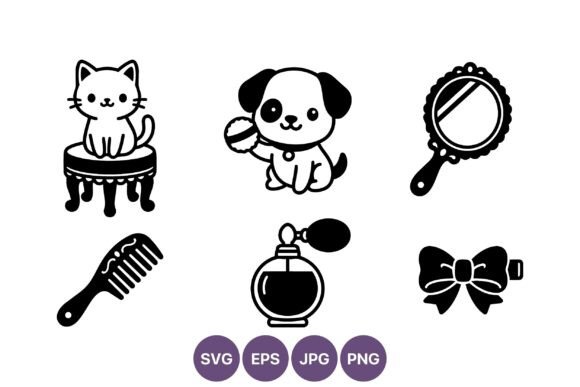
First impression? This isn’t a bold, high-contrast emblem meant for stadium-sized caps or dense sweatshirt logos. Cat and Puppy Line Art with Accessories feels like a quiet, hand-drawn moment—softly confident, gently nostalgic. The cat sits upright on a stool, the puppy holds a ball with gentle weight in its paws, and the accessories (mirror, comb with subtle liquid detail, perfume bottle, bow) orbit them like quiet props in a storybook scene. It’s line art—not filled, not shaded—so it leans into elegance over energy. That makes it ideal for products where subtlety reads as care: baby onesies, linen tea towels, minimalist tote bags, or embroidered pillow covers for a nursery or boutique bedroom.
How It Stitches in Real Life
I tested Cat and Puppy Line Art with Accessories as a machine embroidery design on midweight cotton twill (for a custom apron) and lightweight quilting cotton (for a baby bib). On both, the clean vector lines translated well—but only because I treated it like a *line-based* embroidery file, not a fill-heavy graphic. Running stitch worked beautifully for the outlines; satin stitch would overwhelm the fine details, especially around the comb’s liquid curve or the mirror’s handle. Fill stitch? Not recommended unless you simplify first—the original layout doesn’t support dense coverage without losing legibility.
On a sweatshirt? Yes—but only as a small-to-mid size chest placement (3–4 inches wide), with tear-away stabilizer underneath and careful tension checks. The lines are thin enough that stretchy fabric or uneven tension can cause skipped stitches or wobble in the puppy’s paw or the bow’s knot. On dark fabric? Use bright white or pale ecru thread—not black—so the line art reads as intentional, not lost. And on curved surfaces like caps? Scale down further and avoid the outer edges of the design; the stool base and perfume bottle’s base tend to distort if hooped too tightly near the bill seam.
Where It Shines—and Where to Pause
This design naturally elevates handmade product categories that thrive on warmth and personality: personalized gifts (think monogrammed baby blankets with the cat + puppy beside the name), Etsy seller listings for digital embroidery files, craft fair patches for pet lovers, or boutique kitchen towels where charm matters more than impact. It also works well as an embroidered patch—stitched cleanly on twill, then heat-applied or sewn onto denim jackets or backpacks.
But tread carefully with tiny hoop sizes (< 3 inches), highly textured fabrics (like bouclé or thick terry), or layered garments (e.g., hoodies with inner lining). The comb’s fine teeth and the liquid detail in the perfume bottle’s droplet are easy to lose in stitching if density isn’t dialed back or if thread tension shifts. Also, avoid using it full-size on thin fabrics like voile or rayon challis—those delicate lines will show through or pucker without proper cutaway stabilizer.
What Customers Actually Notice
When I added Cat and Puppy Line Art with Accessories to a set of embroidered tea towels sold in my small shop, customers didn’t just comment on “the cute animals.” They mentioned the *mirror*, the *comb*, the *bow*—small storytelling details that made the piece feel curated, not generic. That’s the quiet strength of this design: it invites closer looking. For Etsy sellers, that translates to longer listing dwell time and higher perceived value. For holiday embroidery or wedding gifts (think “best friend’s new puppy + her cat” keepsake), it feels personal without needing text.
It also supports brand consistency—if your craft business centers on gentle, nature-adjacent, or vintage-tinged aesthetics, this fits right in. But it won’t carry a loud, modern streetwear line. Know your audience. A teen-focused apparel decorator might need to pair it with bolder typography or rework the layout; a nursery brand? It’s ready to go.
Practical Embroidery Designer Notes
- Always test on scrap fabric first—especially with the comb’s liquid detail and the bow’s loop. Those are your stress points.
- Review stitch density before finalizing. If your embroidery software shows >12,000 stitches for the full layout, simplify or reduce scale.
- Confirm hoop size compatibility. The full composition is wider than tall—so a 4×4 hoop may require slight cropping or centering adjustments.
- Inspect small details at 200% zoom in your embroidery software. Look for overlapping paths or stray anchor points that could cause jump stitches.
- Test in black-and-white mockups on light and dark backgrounds—this isn’t a design that relies on color, so contrast must stand alone.
- Use appropriate stabilizer: medium-weight cutaway for knits, tear-away for stable wovens, and lightweight fusible for linens.
- Check licensing terms before selling finished items or bundling the digital embroidery file—especially if you’re an Etsy seller or digital product creator. This is an Illustrations asset, but commercial use rights aren’t implied by format alone.
Final Thought: A Design That Asks for Intention
Cat and Puppy Line Art with Accessories isn’t background noise—it’s a quiet invitation to slow down and notice. It rewards thoughtful execution: the right thread choice, the right stabilizer, the right product context. Used well, it turns a simple tote bag into a cherished gift, a baby onesie into a keepsake, or a craft fair patch into a conversation starter. Used hastily? It risks looking thin, fragile, or lost in the fabric. So give it space. Give it attention. And let its gentle charm do the work it was made for.